 By
By 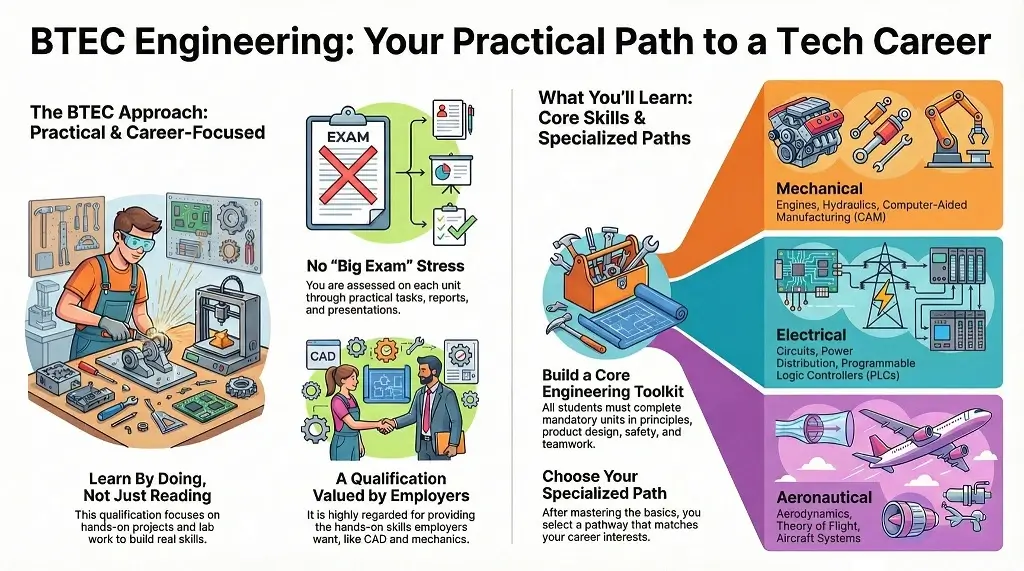
Choosing the right professional path is important for everyone. If you live in Dubai, Abu Dhabi, or any of the Emirates, then you would definitely know that this state loves to think ahead. So if you want to be a part of it (professionally), you need to understand a few things first.
BTEC Engineering is a special way of learning that focuses on practical work rather than reading. In addition, it is a vocational, career-focused qualification, providing hands-on experience in areas like mechanical, electrical, and manufacturing engineering.
Sounds like you? If yes, this guide is for you. We will break down BTEC engineering subjects so you can figure out what you will be learning and its importance in your future.
What are BTEC Units?
Normally, students have “subjects,” but in BTEC, we call them units.
To get your diploma in BTEC (which is equivalent to three A-levels), you need to complete 15 different units in 2 years of time.
Some units are mandatory (all have to do them), while some are optional (you pick what you like).
So, let’s look at the most common ones found in the UAE.
The Core BTEC Engineering Units (Everyone Must Do)
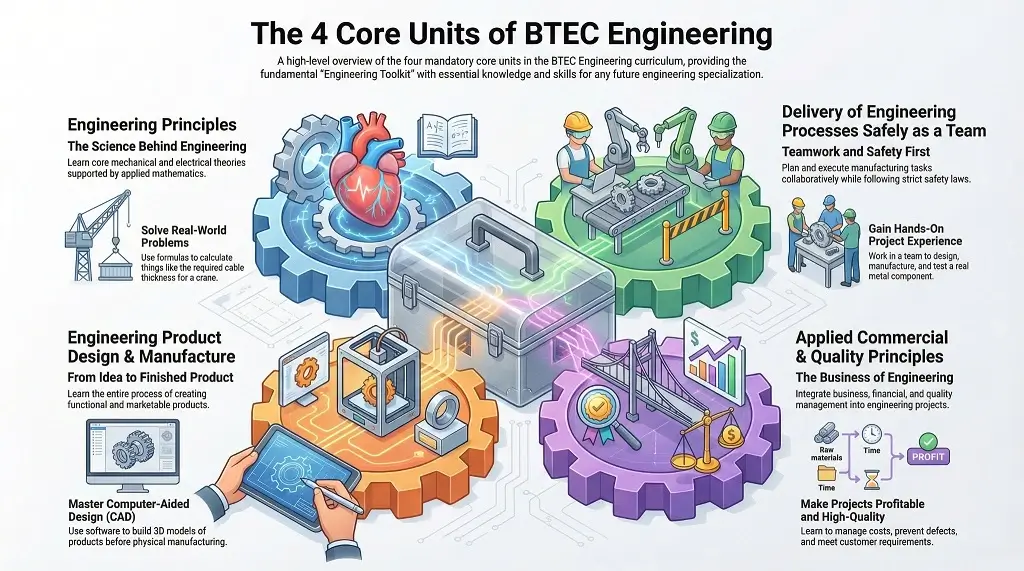
These units give you the basic “Engineering Toolkit.” No matter if you want to build solar panels or planes, you need to learn them first.
1. Engineering Principles
Engineering principles in BTEC cover core mechanical and electrical theories that are heavily supported by applied mathematics. In addition, it focuses on solving technical engineering problems through topics like force, material, circuit, and motion. This is usually assessed via a 120-hour examination that combines both theory and practical practice.
- What you study: You learn the use of formulas to solve real problems. For example, if you are building a crane to lift heavy material at a port, how thick does the cable need to be so it doesn’t snap?
- Why it’s interesting: You learn about Static Force (how buildings stay still) or Dynamic Force (how things move).
2. Delivery of Engineering Processes Safely as a Team
This unit teaches collaborative engineering and focuses on planning, executing, and reviewing manufacturing on service tasks while adhering to strict safety legislation.
- What you study: You learn about risk assessment, effective communication, hazard identification, teamwork, and technical documentation that culminates in a team-based group project. In addition, you also learn how to ensure your own safety throughout.
- The Project Example: As a team, design, manufacture, and test a metal component (e.g, a steel pulley) using a lathe and milling machine. Ensure zero safety incidents and high-quality adherence to technical drawings.
3. Engineering Product Design and Manufacture
Do you ever look at a smartphone and wonder, ‘Who decided that it should look that way?’
This unit teaches the end-to-end process of creating functional and marketable products by combining engineering principles, CAD, and manufacturing technology.
- What you study: The key topics you learn include design methodologies, 3D modeling, material science, rapid prototyping, production management, and quality control. So you begin with an idea, draw it out, choose the best material (like carbon or aluminum), and then figure out how to mass-produce it.
- The Tech: You will spend a lot of time in CAD (Computer-Aided Design). This is a software that lets you build 3D models on screen before you touch anything in real life.
4. Applied Commercial and Quality Principles in Engineering
This unit teaches the integration of business, financial, and quality management principles into engineering projects. You understand business objectives and ensure quality assurance and control, including SIO standards, to prevent defects and meet customer requirements.
- What you study: The key areas covered in this unit are commercial principles and cost management, quality management system, engineering business operations, design for excellence, project management, and communication.
- What you learn: This unit is designed to prepare students for real-world engineering roles by teaching them how to make technical projects both high-quality and profitable.
Specialized BTEC Engineering Units (Choosing Your Favorite Path)
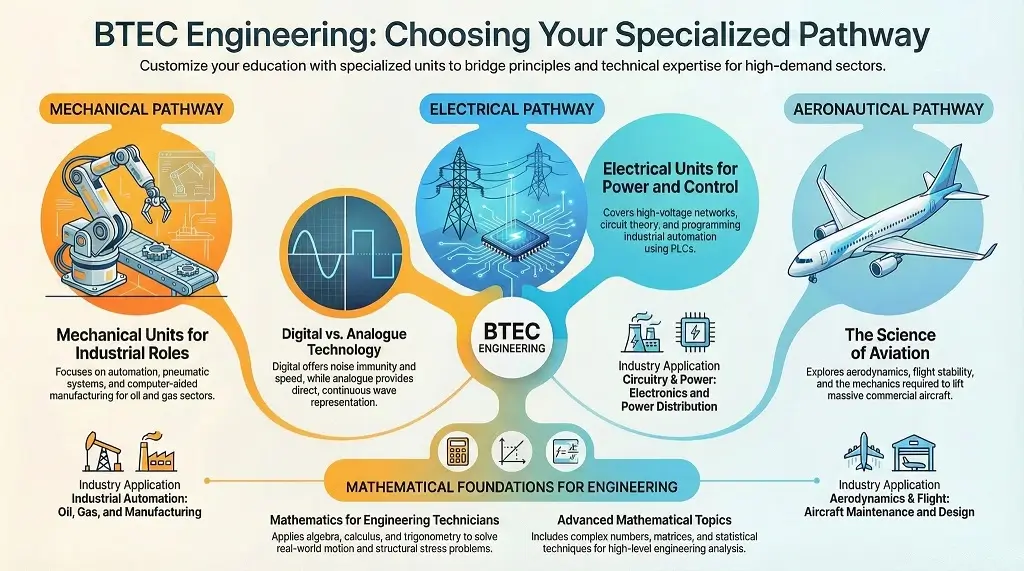
Once you have the basics down, you get to choose subjects that fit your interests.
In the UAE, students generally gravitate toward one of three high-demand sectors. Because these units require extensive technical documentation and data analysis, many students utilize assignment help to ensure their specialized reports meet the high Distinction-level standards required by top universities. These units are:
The “Mechanical” Units
These units cover topics like engines, heat, and moving parts. If you are interested in working in the UAE’s massive industrial or oil and gas fields, then this unit is perfect for you.
1. Pneumatic and Hydraulic Systems
This unit develops skills in designing, operating, and maintaining industrial automation. In addition, students learn to use compressed air (pneumatics) for speed and pressurized oil (hydraulic) for high force.
Additionally, it covers components like actuators, compressors, valves, and pumps, often including electro-pneumatic circuits.
2. Mechanical Measurement and Inspection
This focuses on essential metrology techniques and requires learners to select, use, and calibrate instruments to verify component accuracy against engineering specifications.
In addition, it covers linear, angular, and surface measurement, alongside quality tools like gauges and Statistical Process Control (SPC).
3. Computer-Aided Manufacturing (CAM)
This is a specialized module designed to teach students how to translate computer-aided design (CAD) models into physical components using automated machinery.
Furthermore, you understand the economic and technical benefits of CAM. For example, reduced machine set-up time, improved accuracy, consistency, and the ability to produce complex shapes.
The “Electrical” Units
BTEC Engineering (levels 3-5) electrical units focus on practical and theoretical skills in power, electronics, and control systems.
1. Digital and Analogue Devices
Digital devices (smartphones, laptops, digital cameras, etc) process information using discrete binary (0s and 1s), offering high-accuracy and noise immunity. On the contrary, analogue devices (traditional clocks, radio receivers, dimmer switches) use continuous physical waves to represent data.
Also, digital technology is faster and easier to store, whereas analogue provides a more detailed and direct representation in some cases.
2. Electrical Principles
The Electrical Principle in BTEC Engineering provides essential knowledge of DC and AC circuit theory, magnetism, and capacitance.
Additionally, it focuses on analyzing circuits using Kirchhoff’s law or Ohm’s Law, alongside practical measurement, stimulation, and testing of electrical components.
3. Programmable Logic Controllers (PLC)
This unit focuses on industrial automation, programming, and troubleshooting using industry-standard software and hardware, such as Siemens S7.
Students learn about evolution, types (unitary, modular, rack-mounted), and the architecture of PLCs. In addition, you also develop programs using Ladder Logic, Function Book Diagram (FBD), Structured Text, and Instruction List.
4. Electrical Power Distribution
This course focuses on the design, maintenance, and operation of high-voltage networks. In addition, it covers power generation, transmission, and distribution systems to prepare students for roles as technicians or engineers in the electrical industry.
The “Aeronautical” Units
1. Principles Applications of Aircraft Mechanical Science
This unit covers essential mechanics, thermodynamics, and fluid dynamics needed for aircraft maintenance and design. In this unit, students learn to analyze static forces, stress, kinetics, dynamics, and fluid flows, applying these to real-world aircraft systems.
Moreover, principles of aerodynamics and hydraulics include Bernoulli’s equation to understand lift, drag, and hydraulic system pressure.
2. Theory of Flight
Theory of Flight covers the fundamental principles of flight that focus on the atmosphere, subsonic aerodynamics, aircraft forces (lift, weight, thrust, drag), and stability.
In addition, this explains how the shape of a wing allows a massive Emirates A380 to lift off the ground. This unit prepares students for industry roles by exploring aircraft control surfaces, lift augmentation, and performance during steady flights and maneuvers.
3. Mathematics for Engineering Technicians
Students learn algebraic, trigonometric, and calculus techniques applied to aviation. For example, calculating aerodynamic forces, structural stress, and electrical circuit analysis.
Also, this focuses on solving real-world engineering problems like motion, fluid flow, and AC theory problems.
Moreover, learners can also delve into “Further Engineering Mathematics” for advanced topics. These include:
- Sequences and series.
- Matrices and determinants.
- Advanced statistical and probability techniques
- Binomial and normal distribution
- Complex numbers.
How are BTEC Engineering Units Taught and Graded?
The BTEC Engineering units are taught through a blend of theoretical classroom learning and hands-on, practical work.
Furthermore, they are graded via a mix of internal assessments (assignments marked by teachers) and external assessments (exams or set tasks marked by Pearson).
No “Big Exam” Stress
In a traditional school, students often have to study for a whole year and attempt an exam at the end.
But BTEC is different. For every unit listed above, you will do:
- Practical tasks: Build or fix something in the lab.
- Written reports: Explain what you did and how it worked.
- PowerPoint Presentations: Showing the professor your CAD models for approval.
Grading and Assessment Process
Each unit is graded as Distinction (D), Merit (M), Pass (P), or Unclassified (U).
- Distinction (D): You are the master of that subject and your work is of high-quality. It is equivalent to an A in A-level (or 48 UCAS points).
- Merit (M): You can explain things clearly and solve problems, equivalent to C at A-Levels (or 32 UCAS points).
- Pass (P): You understand the basics. It is equivalent to an E at A-Levels (or 16 UCAS points).
- Unclassified (U): This means that the work produced does not meet the assessment criteria, resulting in a fail.
Internal Assessment
These are set and marked by teachers. They are then internally verified and externally sampled.
Also, the structure of these assignments is designed to meet specific learning aims for Pass, Merit, or Distinction criteria.
It can include reports, presentations, or practical demonstrations. For example, a project on “Delivery of engineering processes safely as a team” or computer-aided design (CAD) tasks.
Also, the unit grades are converted into points, which are summed at the end of the course to determine the final grade (e.g, DDD*, DDD*, or MMM).
If you face any difficulty in writing these assignments, then you can connect with a BTEC assignment help to get professional assistance.
External Assessment
This is set and marked by Pearson, typically taken under controlled conditions.
These comprise two different types:
- Written exams: e.g, Unit 1 Engineering Principles (2-hour problem-solving questions).
- Set tasks: e.g, unit 3 Engineering Product Design and Manufacture (supervised 10-hour task over 3 weeks).
Moreover, students get a maximum of 2 resit exams for external assessments.
FAQs
Is BTEC Engineering good?
BTEC Engineering is a perfect qualification for those who are really good at taking command of their own learning. Employers highly regard it for providing hands-on skills in areas like CAD or mechanics.
Is BTEC better than A-levels?
BTEC is not inherently better than A-levels. BTECs offer direct and practical experience to learners, making them ready for industry, while A-levels (specifically math/physics) are generally preferred for theoretical courses.
Can I pick any BTEC Engineering unit I want?
Usually, your institute will pick the core subjects for you. They will then give a list of optional units to you to pick from. These include mechanics, electrical, and aeronautics units. It’s a great idea to pick units that blend well together, like picking all essential units if you like robotics.
How many hours or weeks do I have to spend on BTEC units?
BTEC Engineering is a full-time course. You will have to spend 15-20 hours per week on these units in the classroom, and extra time at home working on the assignments.
What is D* equivalent to in BTEC?
For the extended certifications based on UCAS points, a D* as same aas A* in A-levels. At level 3, D* represents the highest performance tier, worth 56 UCAS tariff points. For level 2, D* is equivalent to grade 8.5 in GCSE.
Final Words
BTEC Engineering units are designed for students to help them in becoming a real-world problem-solvers. Instead of just reading theories or giving exams, this qualification focuses on hands-on experience and practical learning.
The core BTEC Engineering units include:
- Engineering Principles
- Delivery of Engineering Processes Safely as a Team
- Engineering Product Design and Manufacture
- Applied Commercial and Quality Principles in Engineering.
While selecting optional BTEC units, make sure to know you interest and gather all the right units for you.
By the time you complete this qualification, you will not only get a certificate. But a portfolio of what you have built over the years and what you are capable of building.

